MISSION: EMBEDDED HARDWARE // MONTREAL, QC → ANYWHERE

BENJAMIN
TROST /
HARDWARE
& EMBEDDED

Electrical Engineering @ McGill University, class of '28. I've been building things as long as I can remember: PCs, custom keyboards, and now the boards that run a formula-style EV, from safety-critical circuits to the firmware that ties them together. I went into EE because I like solving complex problems, and vehicle electrical systems have no shortage of them.

FLIGHT LOG

EXPERIENCE

SUMMER 2026

Electrical Engineering Intern

Orbis Labs
  • Developed bare-metal C firmware on STM32, implementing a driver-level FSM managing cellular module init, communication, and state transitions via AT commands.
  • Integrated a cellular module into firmware, configuring CoAP/DTLS for secure remote telemetry on a radar-based flood gauge.
  • Optimized product BOM via schematic analysis and component sourcing, MCUs, LTE modems, USB connectors.
  • Configured and debugged custom BMS hardware in TI BQStudio; overrode protective FETs to wake fuel gauge boards.
  • Architected LabVIEW DAQ testbenches and GUIs validating prototype power and accumulator metrics from accelerometer serial data.
FALL 2025, PRESENT

PCB Project Lead

McGill Formula Electric
  • Lead design, layout, and review of PCBs critical to the vehicle's low-voltage and safety systems: BSPD, LVBMS, TSIL/RTM driver boards, lighting modules.
  • Redesigned brakelight and RTM boards to a low-side switch architecture; moved to aluminum-core PCBs for thermal management.
  • Spearheaded an LVBMS chip-architecture switch, migrating comms UART → SPI for modularity.
  • Mentor new members in Altium Designer schematic capture and layout; set team-wide design standards.
FALL 2024, FALL 2025

Harnessing & DAQ Sub-lead

McGill Formula Electric
  • Helped design, fabricate, and test 8 custom harnesses (500+ wires) to IPC/WHMA-A-620, at a 0.2% error rate.
  • Ran 3 rounds of hardware-in-the-loop integration testing via Hi-Pot and continuity checks; signal integrity and latency analysis on the vehicle CAN architecture with a DSO.
  • Manufactured a 12S3P LiPo low-voltage pack via spot-welding, integrating monitoring lines directly to the LVBMS.
  • Cut total harness subsystem weight 25% through revamped trade studies and manufacturing methodology.
SUMMER 2022

Research Intern

Zon Lab
  • Zebrafish sickle-cell anemia research, injected embryos with experimental treatments, monitored GFP fluorescence for genetic response.
  • Presented findings to 20+ doctors, researchers, and technicians.
HARDWARE BAY

BOARD DESIGNS

// Renders generated from the actual layout files. Ranked by design complexity.

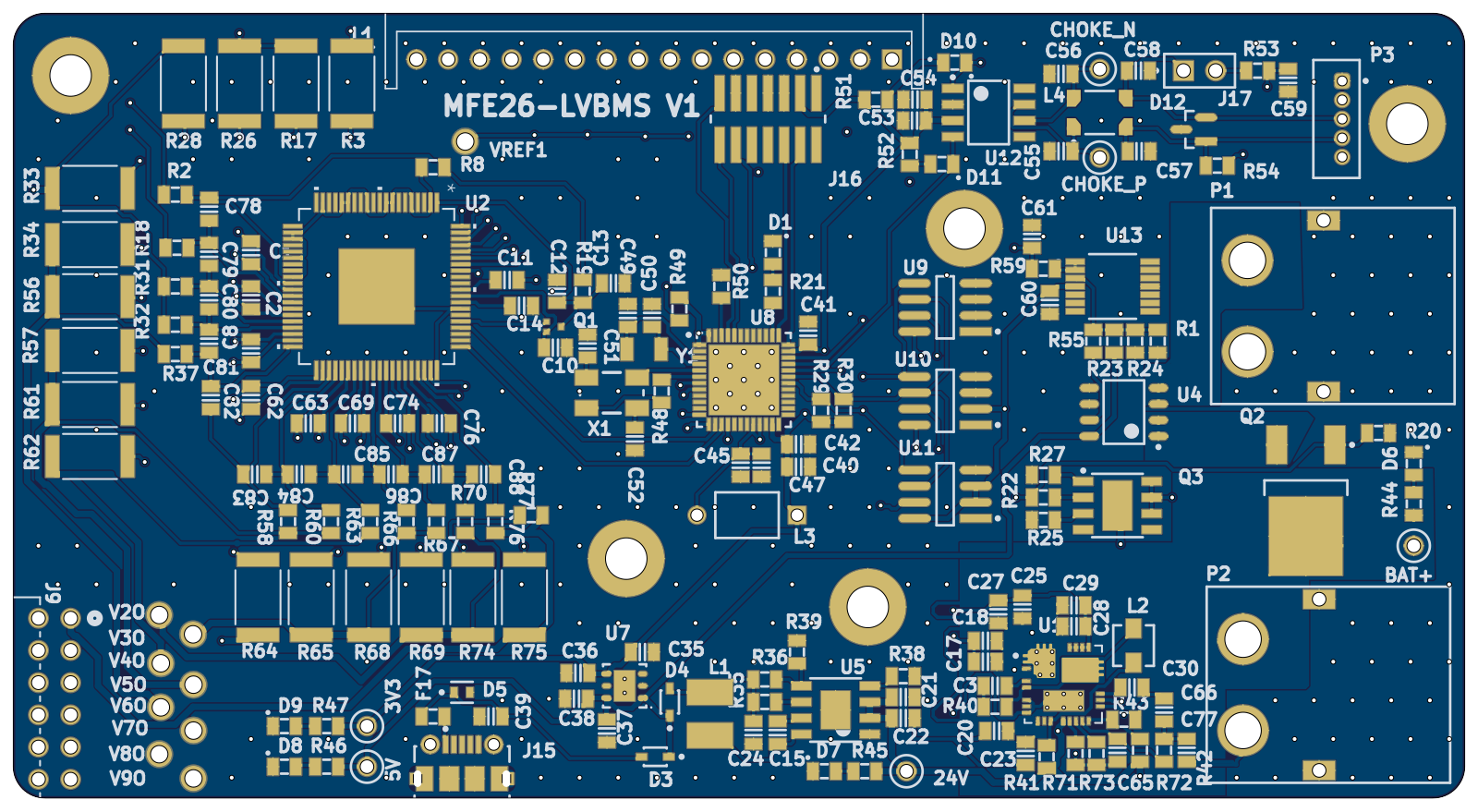
LVBMS printed circuit board, top view
BOARD 01 // FLAGSHIP

LVBMS

Low-Voltage Monitoring System for the LV battery, giving the LV pack the same visibility the rules require for the HV accumulator. Monitors per-cell voltage and temperature across the 12S3P pack (RC-filtered NTC taps off VREF1) and pack current via hall-effect sensor. Passive balancing bleeds every cell down to the lowest cell's potential. Talks SPI to an STM32, which puts telemetry on critical CAN through a transceiver; Q2 gives the MCU a software battery disconnect (LV_SW). Power tree: ~30V pack → 24V (switching reg w/ UVLO) → 5V → 3.3V. Design complete; fab pending.

SPIPASSIVE BALANCINGHALL CURRENT SENSE
4-LAYER // 115 × 62 MM // 249 COMPONENTS // 159 NETS

Pack monitor, drag cell voltages

PACK: - I_PACK: -
CAR BUS

// Passive balancing, live: every cell above the lowest bleeds down to its potential. Drag a cell up and watch it come back. Lowest cell shown green.

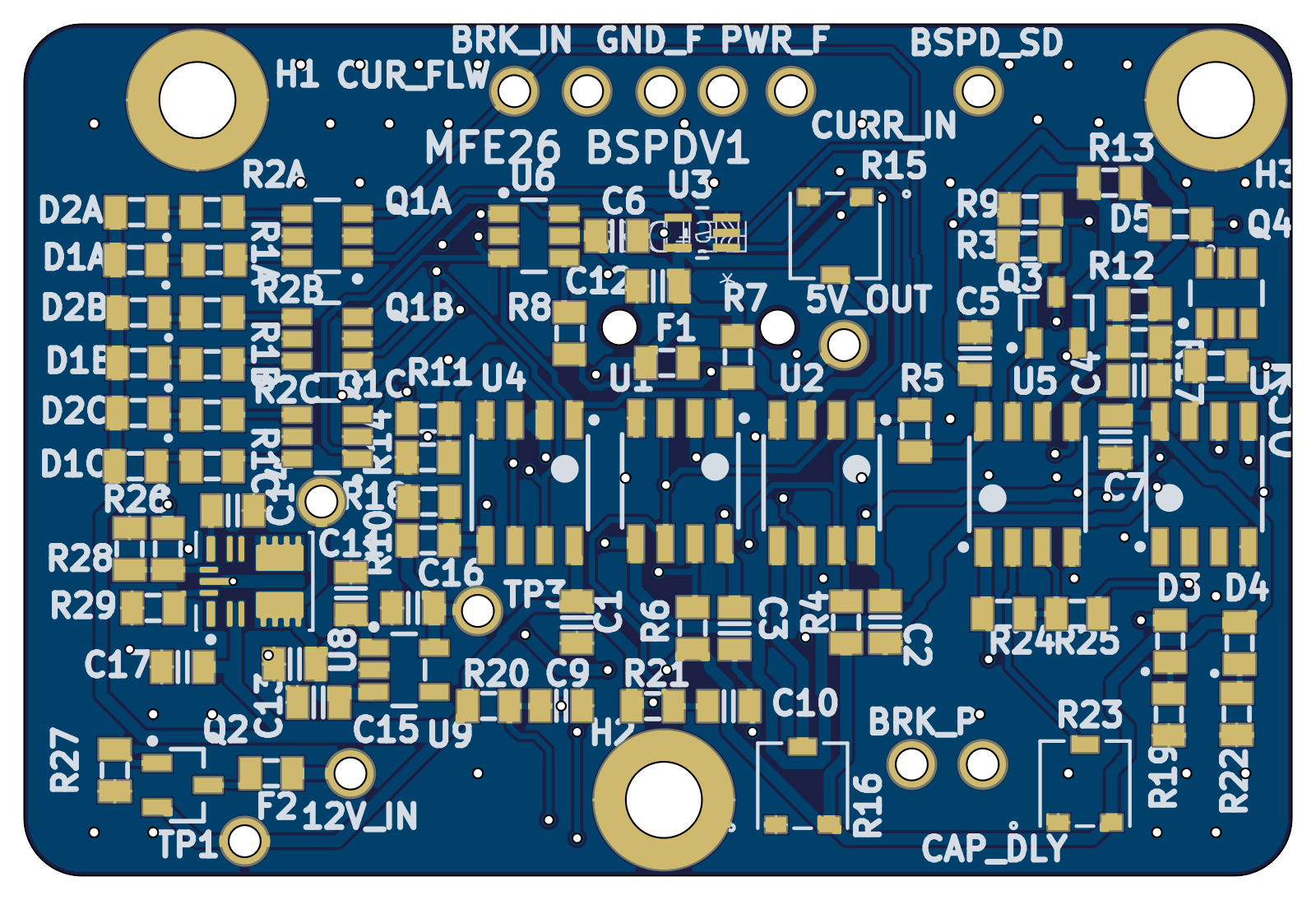
BSPD printed circuit board, top view
BOARD 02 // SAFETY-CRITICAL

BSPD

Brake System Plausibility Device: the rules-mandated, non-programmable circuit that shuts the car down if brake and throttle are pressed together. Open-collector comparators give active-low fault logic in three classes: power fault (sensor > 4.8V), ground fault (sensor < 0.2V), and plausibility fault (brake & current both past their references). Any fault held > 500 ms charges the RC delay past 3.25V and fires BSPD_SD. Thresholds live on 10k pots, retuned yearly, no rework.

ANALOGACTIVE-LOWFSAE RULES
2-LAYER // 55 × 37 MM // 93 COMPONENTS

Sensor inputs

0.50V
0.50V

Reference pots (10k)

1.25V
2.00V
0.70V

Fault logic (active-low)

PWR_FLT GND_FLT PLAUS_FLT U6 NAND

500 ms delay → shutdown

0.00V
BSPD_SD (LATCHED) BRAKELIGHT DRAIN

// BRAKELIGHT drain fires on its own window comparator, above BRAKE_LOW_REF (a third 10k pot on the real board), below the 4.8V rail, independent of the fault tree. Red line on the cap bar = 3.25V trip. Clear the fault before the cap gets there and it discharges; hold it 500 ms and the car is done until power cycle.

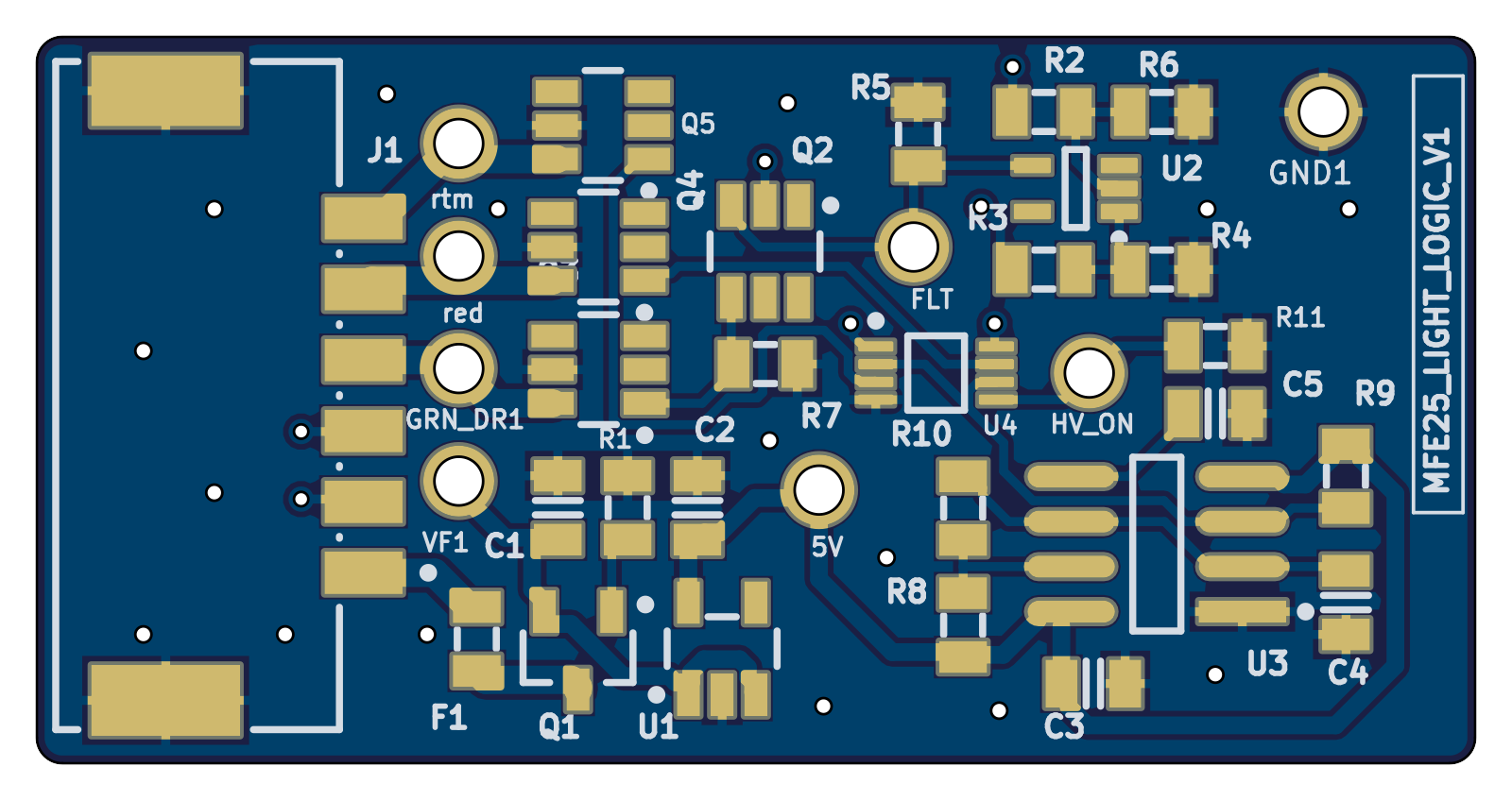
TSIL driver printed circuit board, top view
BOARD 03 // DRIVER

TSIL DRIVER

Drives the tractive-system indicator lights. BMS_SIG and IMD_SIG are active-low faults into a NOR gate: either one sets FLT high, opening the N-channel FET and gating a 555-derived LIGHT_CLOCK through AND gates, flashing red. No fault: FLT low, Q2 → Q3, static green. HV_ON_SIG passes straight through as RTML_OUT to the ready-to-move light.

LOW-SIDE SWITCH555 TIMERNOR/AND LOGIC
2-LAYER // 41 × 21 MM // 35 COMPONENTS

Fault inputs (active-low)

TSIL output

FLT LIGHT_CLOCK RTML_OUT → RTM

// Green steady = system nominal. Either fault low → NOR high → red on the 555 clock.

BOARD 04 // LIGHTING

TSIL + RTM LIGHT BARS

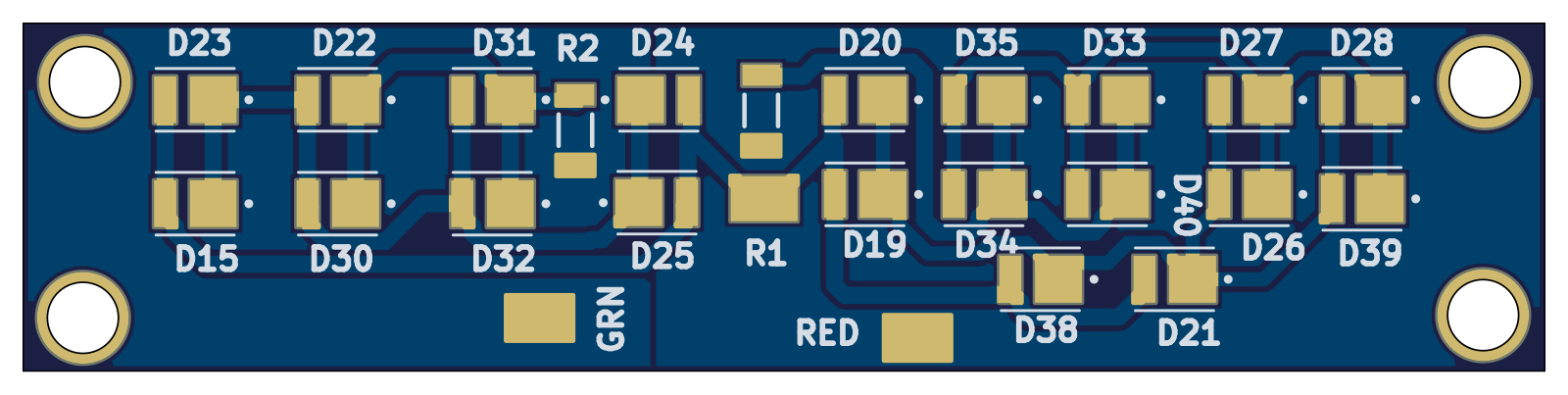
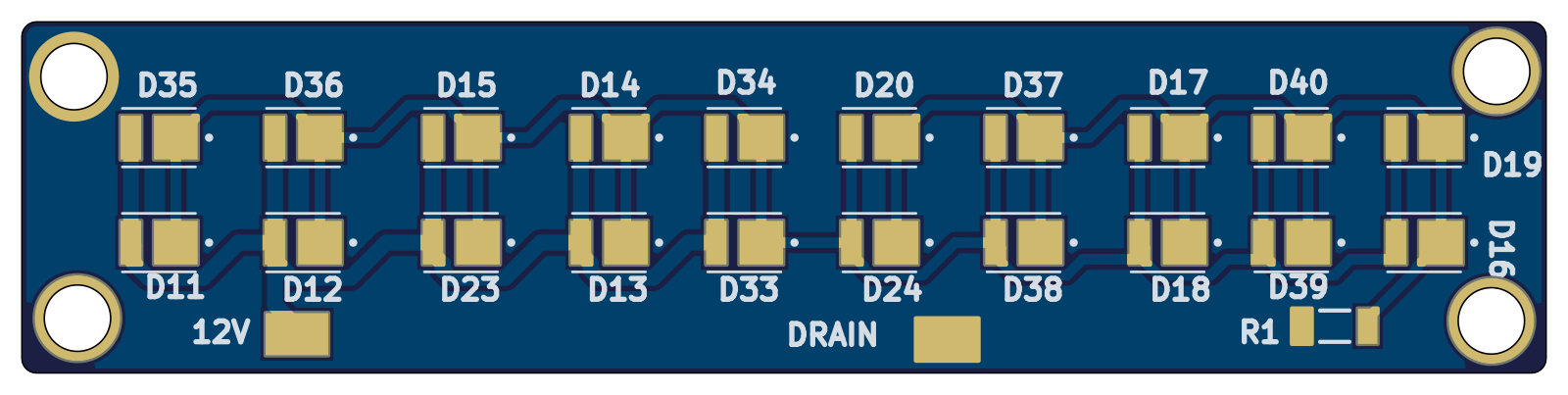
The lights themselves, on aluminum-core PCB. Routed entirely single-sided (zero vias) since metal-core boards can't take plated through-holes cheaply, with traces sized for continuous LED current. TSIL carries two LED sets: green always on when healthy, red flashed by the driver's 555 on a BMS/IMD fault. RTM flashes on the driver's ready-to-move signal.

AL-CORE PCBSINGLE-SIDED0 VIAS
1-LAYER AL-CORE // 68 + 73 MM BARS
Triangular brakelight board
BOARD 05 // LIGHTING

BRAKELIGHT

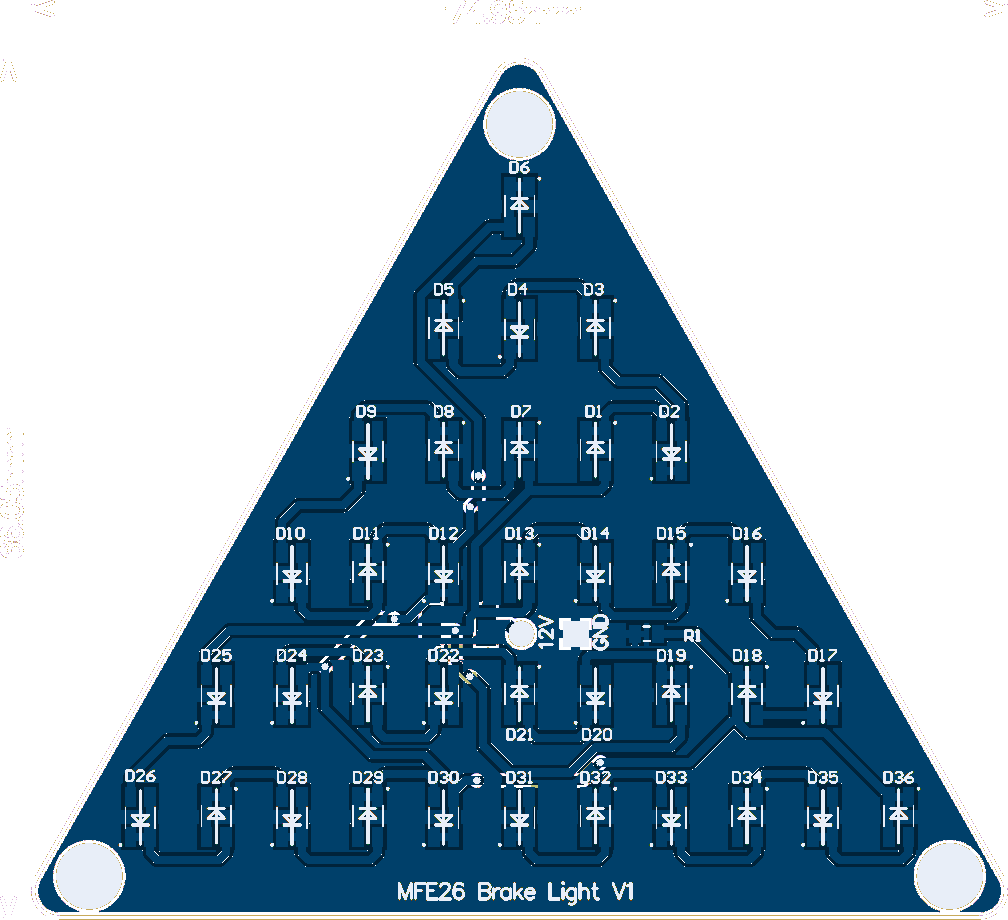
The red triangle at the back of the car: 36 LEDs in six strings behind a resettable PTC fuse, lit by the BSPD's low-side Brake_Light_Drain. All logic lives upstream on the BSPD; this board is just the LED matrix and copper.

LOW-SIDE DRIVEN36 LEDTRIANGULAR
TRIANGULAR // DRIVEN BY BSPD
PRE-FLIGHT

SYSTEMS CHECK

EDA / Software

  • Altium Designer
  • LTSpice
  • RapidHarness
  • TI BQStudio
  • LabVIEW
  • STM HAL · Embedded C
  • Python
  • Linux · Bash
  • Git

Protocols

  • CAN bus
  • SPI · I2C · UART
  • BLE
  • CoAP · DTLS
  • IPC/WHMA-A-620

Hardware & Lab

  • PCB design & layout
  • DSO / signal integrity
  • Harness fabrication
  • Precision soldering
  • Spot welding
  • Hi-Pot testing